


← Back to Blog

Jan 3, 2026 · Teamate Founders

Why Enterprises Can’t Answer “Why” and How Context Graphs Change That

Context GraphsDecision LineageEnterprise AnalyticsOrganizational Context
Context Graphs and Decision Lineage in Teamate

Modern enterprise analytics systems are increasingly good at answering “what happened?” questions:

What was our sales volume over the past three months?
Which campaigns performed best?
What percentage of users converted after a feature launch?

Tools like Databricks, Snowflake, and modern BI platforms are designed precisely for this. With LLMs turning natural language into SQL, factual analytics has become more accessible than ever. From dashboards to ad-hoc queries, enterprises can slice historical data from almost any angle.

But none of these tools can answer a more fundamental question:

Why did this happen?

  • Why did a deal fall through despite strong intent?
  • Why did we prioritize this feature over another?
  • What alternatives did we consider — and why did we reject them?

Causal analytics is missing from enterprise intelligence.

Today, company leaders and operators desperately want answers to these questions — but there are no systems designed to capture them. As a result, they rely on anecdotes, stitching together piecemeal information scattered across Slack threads, meeting notes, and quarterly retrospectives to construct stories that fit their intuition. This is the best available approach to a massive, yet deeply underserved, need.

No one has cracked the causal analytics problem yet.

A recent blog post on context graphs summarized the gap well: context graphs represent not just outcomes, but the decisions, discussions, and reasoning that led to them. Decision-making often happens implicitly, in real time, and across tools. Traditional systems of record were never designed to capture this kind of information.

We strongly resonate and believe solving this requires a fundamentally different approach.

From the beginning, Teamate set out to tackle questions that high-performance, continuously learning teams care about:

  • Why did we do it this way?
  • Could we have done it differently, given what we knew at the time?
  • How would we do it better next time?

Capturing this kind of context cannot be an after-the-fact exercise. Fragmentation exists precisely because decisions happen ad-hoc — in meetings, Slack threads, customer calls, design reviews, and hallway conversations. Any system that depends on manual documentation or forced process will inevitably fail.

That’s why Teamate is designed to be embedded directly into daily workflows.

Teamate is not just an omnipresent AI colleague. It is also infrastructure.

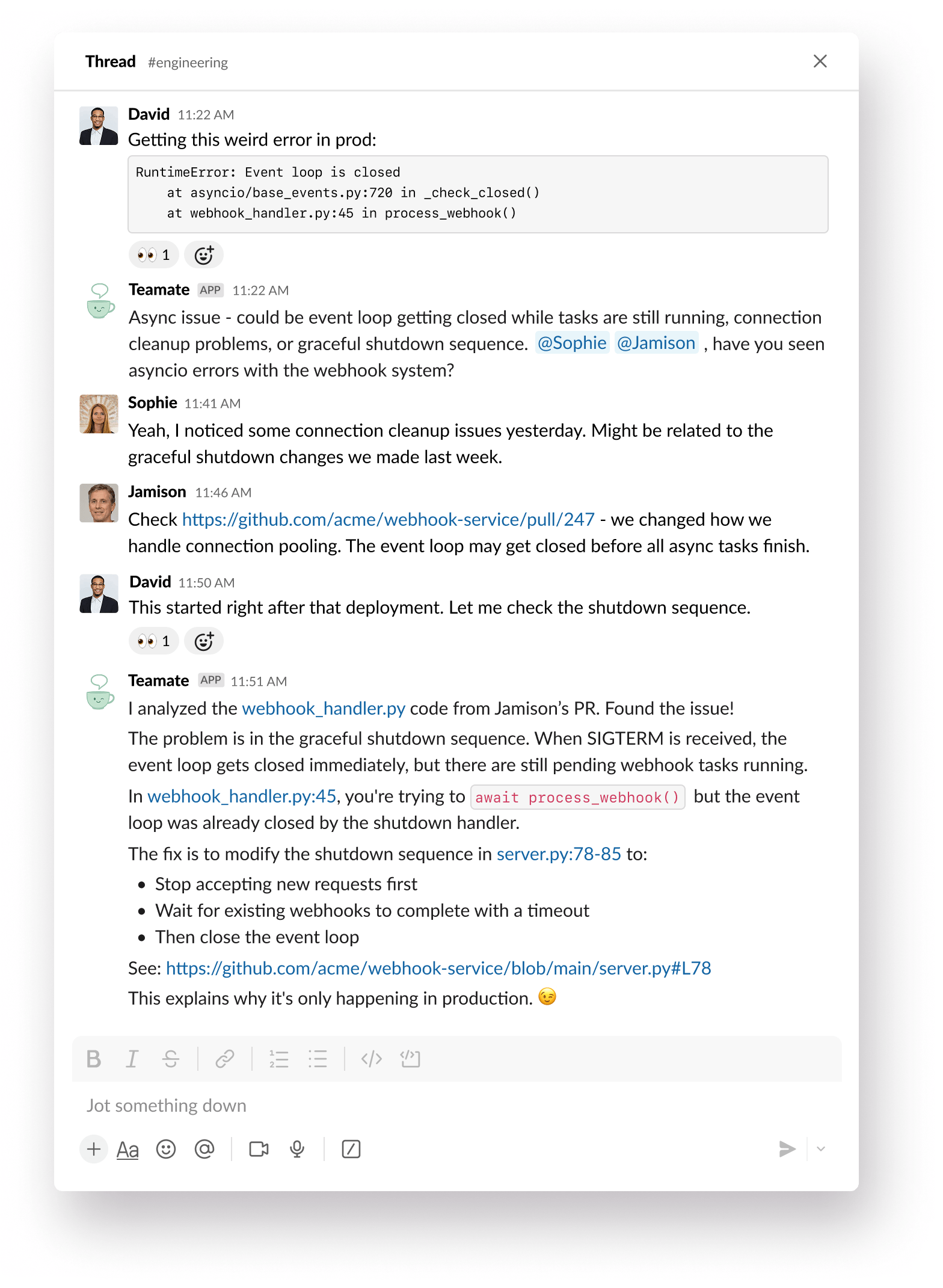
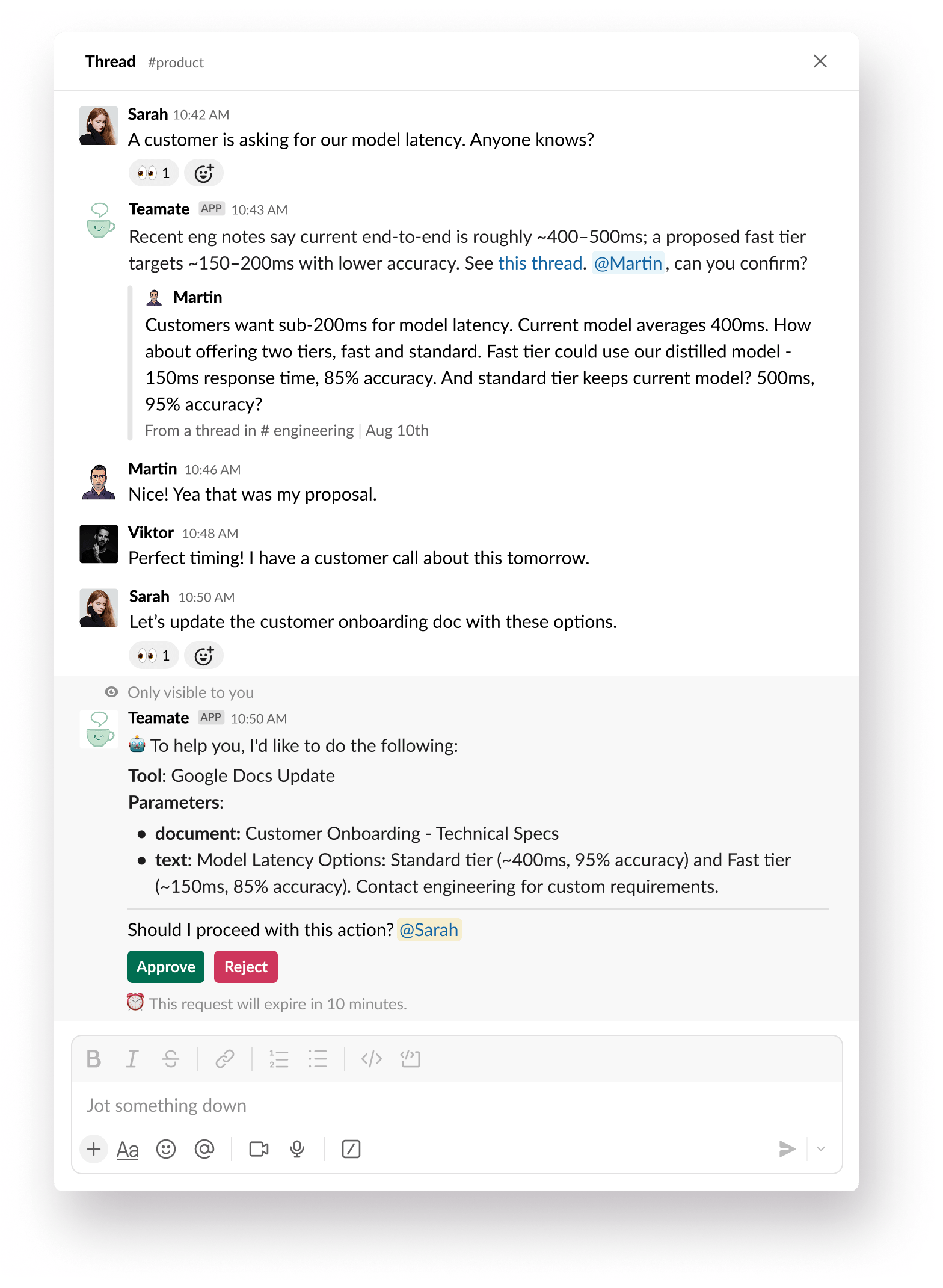
As a collaborator, Teamate participates in discussions, tracks key decisions and their underlying reasoning, and surfaces relevant context when it matters. In the background, it ambiently observes how work actually happens — building a living context graph and decision lineage without interrupting the team. Almost immediately, this makes previously invisible information queryable.

For example:

  • Sales teams can understand why a feature exists — not just that it shipped
  • Product teams can see which customer pains drove prioritization decisions
  • Engineering teams can trace how tradeoffs were made and under what constraints
  • Leaders can ask not only what changed, but why it changed

This is how causal analytics becomes possible — not through better dashboards, but through better capture of human decision-making as it happens.

We believe execution will become cheap in the future. Decisions and insights will become more expensive. And when decision context is captured correctly, its value compounds over time — for teams, for leaders, and for the company as a whole.